Место работы автора, адрес/электронная почта: Северо-Восточный федеральный университет им. М. К. Аммосова, Институт зарубежной филологии и регионоведения ; 677027, г. Якутск, ул. Белинского, 58 ; e-mail: es.rufova@s-vfu.ru, rufl2003@yandex.ru ; https://www.s-vfu.ru/
Ученая степень, ученое звание: канд. филол. наук
Область научных интересов: Языкознание, литературоведение, перевод, межкультурная коммуникация
ID Автора: SPIN-код: 5286-8336, РИНЦ AuthorID: 641472

Количество страниц: 12 с.
- Саха тыла/Якутский язык > Научные труды по якутскому языку > Фразеология,
- Языкознание. Филология. Художественная литература > Языкознание и языки. Лингвистика > Якутский (саха),
- Языкознание. Филология. Художественная литература > Языкознание и языки. Лингвистика > Иностранные языки,
- НАУКА ЯКУТИИ > ЯЗЫКОЗНАНИЕ. ФИЛОЛОГИЯ. ЛИТЕРАТУРОВЕДЕНИЕ. ХУДОЖЕСТВЕННАЯ ЛИТЕРАТУРА > Языкознание и языки. Лингвистика.
This article attempts to conduct a comparative analysis of somatic phraseological units (PU) of the Japanese and Yakut languages. For the first time, special attention is paid to identifying typologically common and specific features of somatic PU of the compared languages; the degree of closeness of PU by semantic correlation is revealed; full, partial, false equivalents and non-equivalent PU in the somatic phraseology of the Japanese and Yakut languages reestablished. The aim of the study is to identify similarities and differences between PU with the component “body part” in the Japanese and Yakut languages from the point of view of interlingual equivalence based on the analysis of their lexical and semantic features. As a result of the study, universal and purely national features in the phrase-formation activity of somatic designations of the studied languages are revealed. In the analyzed languages, somatisms are quite widely used in the phrase-formation process (54 somatic lexemes in Japanese and 55 in the Yakut language). Phraseologically active are mainly the same names of body parts (arm, eye, head). The universality in the use of somatisms in the specified languages is a consequence of the reflection of extralinguistic factors, extralinguistic realities. For example, such human organs as arm, eye, head, heart, leg perform more vital functions than hair, forehead, neck, etc. A specific feature of the use of lexical somatisms in the compared languages is the different, and sometimes contrasting, phrase-formation potential of some somatic lexemes. Thus, the phrase-formation activity of components in different languages can be different.
Руфова, Е. С.
Соматические фразеологические единицы японского и якутского языков: сопоставительный аспект / Е. С. Руфова ; Северо-Восточный федеральный университет им. М.К. Аммосова // Вестник Северо-Восточного федерального университета им. М. К. Аммосова. Серия "Алтаистика". - 2025, N 2 (17). - С. 15-26. - DOI: 10.25587/2782-6627-2025-2-15-26
DOI: 10.25587/2782-6627-2025-2-15-26

Количество страниц: 6 с.
- Общественные науки. Образование > Народное образование. Воспитание. Обучение. Организация досуга > Высшее образование. Высшая школа. Подготовка научных кадров,
- НАУКА ЯКУТИИ > ОБЩЕСТВЕННЫЕ НАУКИ > Народное образование. Воспитание. Обучение. Организация досуга > Высшее образование. Высшая школа. Подготовка научных кадров.
- 1. Кочуров Борис Иванович, Величенко Валерий Владимирович, Писарева Лариса Юрьевна, Колодезников Василий Егорович, Горохов Алексей Николаевич. Анализ воздействия объектов газонефтедобычи на охотничьих млекопитающих родовой общины малочисленных народов "Ботуобуйа" Мирнинского района Якутии = Impact analysis of oil and gas extraction facilities on hanting mammals of the “Botuobuia” (tribal community) of indigenous minorities in the Mirninsky district of Yakutia
- 2. Бебихов Юрий Владимирович, Наумов Евгений Константинович, Семенова Мария Николаевна, Якушев Илья Анатольевич. Воздействие высокоэнергетического нагрева токами высокой частоты на дислокации в условиях повышения коррозионной стойкости = The effect of high-energy heating by high-frequency currents on dislocations in conditions of increased corrosion resistance
- 3. Реев Василий Георгиевич, Гунасекара Утум Джамаял Сулакна. Анализ выбора хладагента для тепловых насосных установок по ключевым критериям = Analysis of the choice of refrigerant for heat pumping units according to key criteria
- 4. Захарова Анна Михайловна. Квазисинонимические полипредикативные конструкции в якутском языке (на материале уступительных конструкций) = Quasi-synonymous polypredicative constructions in the Yakut language: a study of concessive constructions
- 5. Васильев Василий Васильевич. Термин "тональность": интегративный подход в лингвистических исследованиях = The term “tonality”: an integrative approach in linguistic research
- 6. Иванова Раиса Петровна. Когнитивно-семиотическое моделирование лексики тактильной перцепции в якутском языке = Cognitive-semiotic modeling of tactile perception vocabulary in the Sakha (Yakut) language
- 7. Ноева Саргылана Еремеевна. Пространственный миф в якутском городском тексте: специфика и функции = Spatial myth in the Yakut urban text: specifics and functions
- 8. Тохтобина Яна Егоровна. Лексика неживой природы якутского языка с компонентом-зоонимом: структурные и семантические способы номинации = Inanimate nature vocabulary of the Yakut language with a zoonymic component: structural and semantic ways of nomination
- 9. Чаунина Наталья Владимировна. Рецепция личности и творчества Пушкина в лирике якутских поэтов XX–начала XXI века = Reception of Pushkin’s personality and works in the lyrics of Yakut poets of the 20th – early 21st centuries
- 10. Григорьева Людмила Павловна, Васильева Татьяна Ниловна, Егорова Саргылана Ивановна. К юбилею известного ученого, литературоведа, профессора СВФУ Прасковьи Васильевны Сивцевой-Максимовой = To the anniversary of Praskovya Vasilievna Sivtseva-Maksimova, a famous scientist, literary critic, and professor of NEFU
- 11. Казанцев Владимир Сергеевич, Кривенок Людмила Алексеевна, Тананаев Никита Иванович, Кураков Сергей Анатольевич, Баишев Ньургун Егорович, Агафонова Светлана Андреевна. Резолюция Всероссийской научно-практической конференции "Эмиссия метана из экосистем Севера: методы, инструменты, результаты" = Resolution of the All-Russian scientific and practical conference “Methane emission from Northern ecosystem: methods, tools, and results”
- 12. Тарабукина Марфа Васильевна, Самсонова Лариса Николаевна. Светлый образ учителя = The bright image of the teacher
- 13. Вестник Северо-Восточного федерального университета им. М. К. Аммосова, 2025, №2 (100)
Руфова, Е. С.
Путь на Восток: к 25-летнему юбилею кафедры восточных языков и страноведения ИЗФиР СВФУ / Е. С. Руфова, С. Н. Барашкова, Т. Н. Пермякова ; Северо-Восточный федеральный университет им. М. К. Аммосова // Вестник Северо-Восточного федерального университета им. М. К. Аммосова. - 2025. - Т. 22, N 2 (100). - С. 238-243

Источник: Вестник Северо-Восточного федерального университета им. М. К. Аммосова. Серия "Алтаистика". - 2025. - N 1 (16)
Количество страниц: 9 с.
- Языкознание. Филология. Художественная литература > Литература. Литературоведение > Прочие литературные жанры,
- Языкознание. Филология. Художественная литература > Литература. Литературоведение > Теория литературы. Изучение литературы. Литературная техника > Художественная литература на отдельных языках,
- НАУКА ЯКУТИИ > ЯЗЫКОЗНАНИЕ. ФИЛОЛОГИЯ. ЛИТЕРАТУРОВЕДЕНИЕ. ХУДОЖЕСТВЕННАЯ ЛИТЕРАТУРА > Литература. Литературоведение.
This article is devoted to the problem of emotiveness as a linguistic category expressed by specific means of expressing emotions in the text. The relevance of the study is due to the fact that detailing the ethnocultural specificity of the sign reflection of the emotive component of the linguo-semiotic picture of the world helps to improve intercultural understanding and strengthen ties between different communities. The study is also of interest in view of the growing interest in studying the problem of emotiveness as one of the most important aspects of communication. The purpose of the study is to identify the lexical and semantic features of the representation of the emotive “fear” in the works of the Japanese genre kaidan. As a result of the study, we come to the conclusion that the analysis of synonymous lexemes expressing “fear” in the Japanese language shows that each lexical unit is distinguished by several differential semantic features, while Japanese vocabulary has a bright figurative internal form embedded in the semantics of the word itself, therefore it is less dependent on a specific context or compatibility. In the Japanese stories of the kaidan genre that we selected, the semantics of the lexical units of the Japanese language expressing the concept of “fear” varies in a fairly wide range of shades depending on the nature of the threat, the cause and the specifics of experiencing this feeling. Thus, in the texts of the analyzed Japanese stories, intense emotions of “horror”, “fright”, “anxiety” are most often conveyed, rather than prolonged “phobia” or “fear”. Thus, the lexical-semantic analysis of the components of the emotive “fear” showed that in the texts of Japanese kaidan stories, verbs are predominantly used that convey actions and reactions (conscious or unconscious), rather than adjectives and adverbs that describe the feeling or state of fear.
Руфова, Е. С. Лексико-семантическая характеристика эмотива "страх" в японских рассказах жанра кайдан / Е. С. Руфова, К. Д. Мосорина ; Северо-Восточный федеральный университет им. М. К. Аммосова // Вестник Северо-Восточного федерального университета им. М. К. Аммосова. Серия "Алтаистика". - 2025. - N 1 (16). - С. 27-35. - DOI: 10.25587/2782-6627-2025-1-27-35
DOI: 10.25587/2782-6627-2025-1-27-35

Количество страниц: 10 с.
- Языкознание. Филология. Художественная литература > Языкознание и языки. Лингвистика > Другие языки,
- НАУКА ЯКУТИИ > ЯЗЫКОЗНАНИЕ. ФИЛОЛОГИЯ. ЛИТЕРАТУРОВЕДЕНИЕ. ХУДОЖЕСТВЕННАЯ ЛИТЕРАТУРА > Литература. Литературоведение,
- НАУКА ЯКУТИИ > ЯЗЫКОЗНАНИЕ. ФИЛОЛОГИЯ. ЛИТЕРАТУРОВЕДЕНИЕ. ХУДОЖЕСТВЕННАЯ ЛИТЕРАТУРА > Языкознание и языки. Лингвистика.
This article is devoted to the problem of the gluttonic picture of the world and its implementation in the form of Japanese gluttonic discourse as a phenomenon with high communicative significance. The relevance of the study is due to the fact that detailing the ethnocultural specificity of the sign reflection of the gluttonic aspect of the ligvosemiotic picture of the world helps to improve intercultural understanding and strengthen ties between different communities. The study is also of interest due to the small number of studies in this area and the growing interest in the study of gluttonic discourse, which is one of the most important types of communication. The purpose of the study is to identify the presentation specificity of Japanese gluttonic communication using culinary anime as an example. As a result of the study, we come to the conclusion that the presentation function of anime is realized through gluttony signs as a means of influencing society and, therefore, forms dominant cultural preferences and gastronomic stereotypes of behavior. In anime, there is a clear consistency of non-verbal means with verbal components that allow us to interpret the image. The presentation of anime is realized through adjectives and adverbs that convey a clearly expressed positive assessment when describing the taste of a dish, its texture and other qualities, which may include descriptions of dishes, the general atmosphere, relationships with other participants in the discourse. Color, which builds an associative series, additional graphic elements and sound accompaniment, acquires special significance in the presentation of gluttony signs in anime. Moreover, the setting of the frame, the use of a close-up, as well as quickly changing pictures become an additional means of artistic impact on the viewer, enhancing the effect of gluttony communication.
Руфова, Е. С.
Презентационная специфика глюттонической коммуникации в японских кулинарных аниме / Е. С. Руфова, А. А. Матаннанова ; Северо-Восточный федеральный университет им. М. К. Аммосова // Вестник Северо-Восточного федерального университета им. М. К. Аммосова. - 2024. - Т. 21, N 4 (98). - С. 191-200. - DOI: 10.25587/2222-5404-2024-21-4-191-200
DOI: 10.25587/2222-5404-2024-21-4-191-200
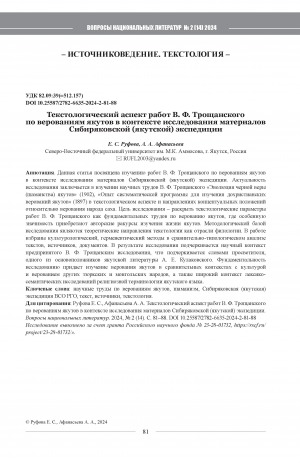
Количество страниц: 8 с.
- Религия. Теология,
- Общественные науки. Образование > Этнография. Обычаи. Жизнь народа. Нравы,
- Краеведение. Археология. География. Биографии. История > Общие вопросы. География как наука. Географические исследования,
- НАУКА ЯКУТИИ > ОБЩЕСТВЕННЫЕ НАУКИ > Этнография. Обычаи. Жизнь народа. Нравы,
- НАУКА ЯКУТИИ > РЕЛИГИЯ. ТЕОЛОГИЯ.
This article is devoted to the study of Vasily Troshchansky's works on Sakha beliefs in the context of researching the materials of the Sibiryakov (Yakut region) expedition. The relevance of the research lies in the study of Troschansky's scholarly works "The Evolution of the Black Faith (Shamanism) of the Yakuts" (1902), "The Experience of a Systematic Programme for the Study of Pre-Christian Beliefs of the Yakuts" (1897) in the textological aspect and directions of conceptual provisions concerning the beliefs of the Sakha people. The aim of the study is to reveal the textological parameters of Troschansky's works as fundamental works on Yakut beliefs, where the author's angles of studying Yakut life acquire special signicance. The theoretical directions of textology as a branch of philology are the methodological basis of the research. The work chooses cultural, hermeneutic methods in comparative-typological analysis of texts, sources, documents. The study emphasises the scientic context of the research undertaken by Troschansky, which is underlined by the words of the enlightener, one of the founders of Yakut literature Alexei Kulakovsky. The study of Yakut beliefs in comparative contexts with the culture and beliefs of other Turkic and Mongolian peoples, as well as the broad context of lexical and semantic studies of religious terminology of the Yakut language adds to the fundamental nature of the research.
Руфова, Е. С. Текстологический аспект работ В. Ф. Трощанского по верованиям якутов в контексте исследования материалов Сибиряковской (якутской) экспедиции / Е. С. Руфова, А. А. Афанасьева ; Северо-Восточный федеральный университет им. М. К. Аммосова // Вестник Северо-Восточного федерального университета им. М. К. Аммосова. Серия "Вопросы национальных литератур". - 2024, N 2 (14). - С. 81-88. - DOI: 10.25587/2782-6635-2024-2-81-88
DOI: 10.25587/2782-6635-2024-2-81-88
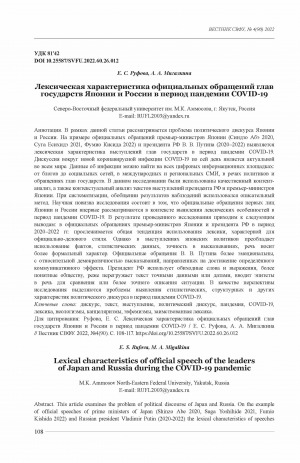
Количество страниц: 10 с.
- Языкознание. Филология. Художественная литература > Языкознание и языки. Лингвистика > Русский язык,
- Языкознание. Филология. Художественная литература > Языкознание и языки. Лингвистика > Иностранные языки,
- НАУКА ЯКУТИИ > ЯЗЫКОЗНАНИЕ. ФИЛОЛОГИЯ. ЛИТЕРАТУРОВЕДЕНИЕ. ХУДОЖЕСТВЕННАЯ ЛИТЕРАТУРА > Языкознание и языки. Лингвистика.
Руфова, Е. С. Лексическая характеристика официальных обращений глав государств Японии и России в период пандемии COVID-19 / Е. С. Руфова, А. А. Мигалкина ; Северо-Восточный федеральный университет им. М. К. Аммосова // Вестник Северо-Восточного федерального университета им. М. К. Аммосова. - 2022. - N 4 (84). - С. 108-117. - DOI: 10.25587/SVFU.2022.60.26.012
DOI: 10.25587/SVFU.2022.60.26.012
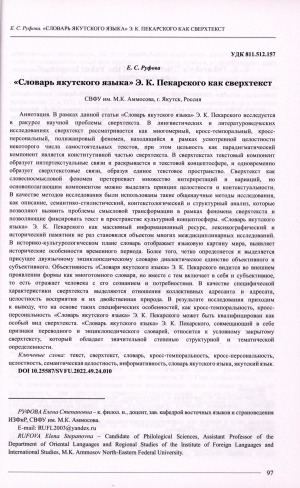
Количество страниц: 10 с.
Руфова, Е. С. "Словарь якутского языка" Э. К. Пекарского как сверхтекст / Е. С. Руфова // Вестник Северо-Восточного федерального университета им. М. К. Аммосова. – 2022. – N 1 (87). – С. 97-105
DOI: 10.25587/SVFU.2022.49.24.010