- Бурятский (1)
- Чукотский (10)
- Долганский (8)
- Английский (46)
- Эвенкийский (36)
- Эвенский (54)
- Французский (11)
- Немецкий (7)
- Хантыйский (1)
- Корякский (3)
- Нанайский (4)
- Нивхский (4)
- Старорусский (2)
- Русский (2278)
- Латинская графика (31)
- Тунгусский (20)
- Турецкий (15)
- Тувинский (2)
- Якутский (357)
- Юкагирский (15)
Количество страниц: 6 с.
- 1. Гурвичевские чтения-2025: сборник материалов II Всероссийской научно-практической конференции с международным участием. (г. Якутск, 29 апреля 2025 г.), 2025
- 2. Алексеева Сардана Васильевна. Ученик Гурвича, этносоциолог Д. Г. Брагина = Gurvich’s pupil, ethnosociologist D. G. Bragina
- 3. Андреева Мария Витальевна. Опыт реализации образовательного курса "Пишем проект - получаем грант" в арктических районах Якутии = Implementation of the educational course “Write a project - get a grant” in the arctic regions of Yakutia
- 4. Баторов Афанасий Раднаевич. Креативная Арктика в цифре: концепция и перспективы формирования единого цифрового пространства культуры = Creative Arctic in digital form: concept and prospects for forming a unified digital cultural space
- 5. Ефимова Екатерина Михайловна. От древности до современности: эволюция традиционной одежды якутов = From antiquity to modernity: the evolution of traditional yakut clothing
- 6. Ефремов Дьулустаан Данилович. Экслибрисы в дарственной коллекции Уллы Йохансен = Ex-libris in the donation collection of Ulla Johansen
- 7. Захарова Екатерина Ивановна. Научное наследие Ильи Самуиловича Гурвича: сохранение и популяризация уникальной коллекции североведа = Scientific heritage of Ilya Samuilovich Gurvich: preservation and popularization of the unique collection of the northern scholars
- 8. Иванова Айталина Семеновна. Книги с инскриптами в семейной коллекции Лебедевых = Books with inscriptions from the collection of the Lebedev family
- 9. Никифорова Екатерина Николаевна. Оде - эвенкийский оберег "Душа ребенка" на примере двух уникальных музейных единиц Жиганского исторического музея = The ode - “The soul of a child” evenki amulet on the example of two unique museum units of Zhigansky historical museum
- 10. Николаева Саргылана Руслановна. Роль информационных краеведческих ресурсов Национальной библиотеки Республики Саха (Якутия) в сохранении культурного наследия = The role of local history information resources of the NB RS(Y) in preserving cultural heritage
- 11. Семенова Саина Андреевна . Неотрадиционализм на примере религиозных верований якутов = Neo traditionalism on the example of yakuts’ religious beliefs
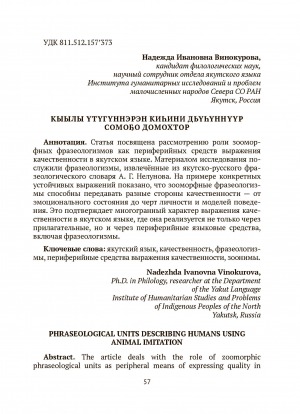
The article deals with the role of zoomorphic phraseological units as peripheral means of expressing quality in the Yakut language. The material of the study was phraseological units extracted from the Yakut-Russian phraseological dictionary of A.G. Nelunov. Using specific set expressions as an example, it is shown that zoomorphic phraseological units are capable of conveying different aspects of quality - from emotional state to personal itytraits and behavioral patterns. This confirms the multifaceted nature of expressing quality in the Yakut language, where it is realized not only through adjectives, but also through peripheral linguistic means, including phraseological units.
Винокурова, Н. И.
Кыылы үтүгүннэрэн киһини дьүһүннүүр сомоҕо домохтор / Винокурова Н.И. ; Институт гуманитарных исследований и проблем малочисленных народов Севера СО РАН // Гурвичевские чтения-2025 : сборник материалов II Всероссийской научно-практической конференции с международным участием : (г. Якутск, 29 апреля 2025 г.) / Арктический государственный институт культуры и искусств, Национальная библиотека Республики Саха (Якутия), Институт гуманитарных исследований и проблем малочисленных народов Севера СО РАН [и др.] ; ответственный за выпуск С. В. Максимова ; составители: А. В. Таппырова, Е. И. Захарова ; редакционная коллегия: Е. Н. Романова, Е. С. Сергина, А. С. Иванова, Н. Э. Игнатьева. - Якутск : ИЦ НБ РС(Я), 2025. - 1 файл (222, [1] с. ; 16 Мб). - С. 57-62.

Издательство: СӨ НБ БК
Год выпуска: 2026
Количество страниц: 83 с.
- Саха тыла/Якутский язык > Научные труды по якутскому языку > Лексикология,
- Саха тыла/Якутский язык > Учебные издания > Школьникам, педагогам,
- Саха тыла/Якутский язык > Учебные издания > Студентам,
- Языкознание. Филология. Художественная литература,
- ШКОЛА > Предметные подборки > Языкознание > Якутский язык,
- ЭЛЕКТРОННОЕ ИЗДАТЕЛЬСТВО > Учебная литература.
Количество страниц: 15 с.
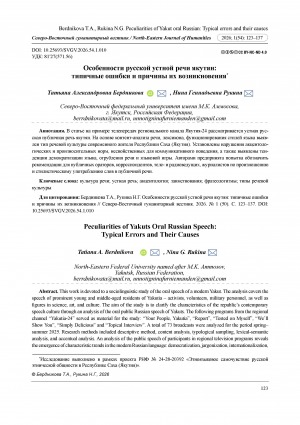
This work is devoted to a sociolinguistic study of the oral speech of a modern Yakut. The analysis covers the speech of prominent young and middle-aged residents of Yakutia – activists, volunteers, military personnel, as well as figures in science, art, and culture. The aim of the study is to clarify the characteristics of the republic’s contemporary speech culture through an analysis of the oral public Russian speech of Yakuts. The following programs from the regional channel “Yakutia-24” served as material for the study: “Your People, Yakutia”, “Report”, “Tested on Myself”, “We’llShow You”, “Simply Delicious” and “Topical Interview”. A total of 73 broadcasts were analyzed for the period spring–summer 2025. Research methods included descriptive method, content analysis, typological sampling, lexical-semantic analysis, and accentual analysis. An analysis of the public speech of participants in regional television programs reveals the emergence of characteristic trends in the modern Russian language: democratization, jargonization, internationalization, and language play. These processes, on the one hand, reflect the natural development of the linguistic system, and on the other, require increased attention to the norms of literary language, especially in the public sphere, where speech serves an important educational and pedagogical function.
Бердникова, Т. А.
Особенности русской устной речи якутян: типичные ошибки и причины их возникновения / Т. А. Бердникова, Н. Г. Рукина ; Северо-Восточный федеральный университет им. М. К. Аммосова // Северо-Восточный гуманитарный вестник. - 2026. - N 1 (54). - С. 123-137. - DOI: 10.25693/SVGV.2026.54.1.010
DOI: 10.25693/SVGV.2026.54.1.010

Количество страниц: 13 с.
- 1. Алексеева Валентина Федоровна. Концептуализация понятия счастье в обыденном сознании участников виртуального дискурса (на материале электронных открыток-мотиваторов на русском языке) = Conceptualization of concept happiness in the everyday consciousness of participants in virtual discourse (material of motivational electronic postcards in Russian language)
- 2. Яковлева Капитолина Максимовна, Прокопьева Александра Николаевна, Иванова Лидия Федотовна, Семенова Саина Андреевна. Якутское головное украшение бастынга: символика и современные интерпретации = The Yakut bastynga headdress: symbolism and modern interpretations
- 3. Добжанская Оксана Эдуардовна. Полевые этномузыковедческие исследования коренных народов Таймыра в 1980–2010-е гг.: научная школа Ю. И. Шейкина = Ethnomusicological fieldwork among Taimyr indigenous groups: the scholarly legacy of Iu.I. Sheikin
- 4. Охлопков Валерий Васильевич. История изучения керамики белькачинской культуры среднего неолита Якутии: итоги и перспективы = The history of the study of the Middle Neolithic Belkachi Culture ceramics in Yakutia: results and prospects
- 5. Северо-Восточный гуманитарный вестник, 2026, №1
This article presents a cognitive-semiotic analysis of auditory perception adjectives in the Yakut language. It reveals a core-peripheral structure with a core tyastaah (тыастаах) and peripheral lexemes of intensity dorkoonnooh, darbaannaah (дорҕоонноох, дарбааннаах) and non-intensity chuumpu, nagyl (чуумпу, наҕыл). It is demonstrated that acoustic characteristics are semiotized through metaphorical transfers (loud sound → glory, silence → well-being). Synesthetic connections and cultural specificity of sound categorization are revealed, reflecting the values of the Yakut linguistic culture. Particular attention is paid to the pragmatic ambivalence of lexemes and their role in representing the traditional worldview. The study contributes to the theory of the linguistic worldview of the Turkic peoples of Siberia.
Иванова, Р. П.
Прилагательные слуховой перцепции якутского языка: когнитивно-семиотический ракурс / Р. П. Иванова ; Политехнический институт (филиал) Северо-Восточного федерального университета им. М. К. Аммосова // Северо-Восточный гуманитарный вестник. - 2026. - N 1 (54). - С. 86-98. - DOI: 10.25693/SVGV.2026.54.1.007
DOI: 10.25693/SVGV.2026.54.1.007

Количество страниц: 12 с.
The article is devoted to the analysis of names of settlements of the Republic of Sakha (Yakutia), formed from hydronyms and hydrogeographic terms. Russian Russian linguists are interested in such a stratum of the Russian toponymic system as the regional oikonymicon, which includes and has been consolidated as proper names, in addition to Russian proper names, the names of water bodies and hydrogeographic terms in the languages of the peoples living in the territory (Yakut, Even, Evenki, Yukaghir). In this regard, the aim of the work was to determine the role of hydronyms and hydrogeographic terms in the formation of names of settlements in the Republic of Sakha (Yakutia), as well as the names of administrative units - districts and uluses (of which 73.5% of the names were derived from hydronyms). As a result of the conducted research, it was determined that the names of almost all major rivers of Yakutia, as well as lakes, are used in the formation of oikonyms through transonymization, which is associated with the economic and cultural activities of the peoples living in the republic. Using a continuous sampling method from the "Dictionary of Toponyms of the Republic of Sakha (Yakutia): settlements, villages, uluses, districts" it was revealed that out of 694 oikonyms, 56 names contain a direct reference to the geographical term "river", "lake", "stream", "swamp", etc. in various languages (Russian, Yakut, Even, Evenki, Yukaghir). It has been established that the most frequent among the oikonyms of the region are those formed from the appellatives kuel (yak. kuol "lake"), "river" (from yak. ureh), Topological bases are also involved in the formation of names of settlements-allegorical names of water bodies (Yakut ebe ’grandmother', Yukaghir abuchie 'grandmother, grandmother'), which may indicate the cultural traditions of the peoples.
Печетова, Н. Ю.
Гидронимы и гидрогеографические термины в ойконимиконе Республики Саха (Якутия) / Н. Ю. Печетова, Т. М. Никаева ; Северо-Восточный федеральный университет им. М. К. Аммосова // Вестник Северо-Восточного федерального университета им. М. К. Аммосова. - 2025. - Т. 22, N 4 (102). - С. 187-198. - DOI: 10.25587/2222-5404-2025-22-4-187-198
DOI: 10.25587/2222-5404-2025-22-4-187-198

Количество страниц: 7 с.
This article presents a typological study of prototypical objects for basic color terms (‘black’, ‘white’, ‘red’, ‘yellow’, ‘blue’, ‘green’) across structurally and genetically diverse languages - Sakha, Russian, Finnish, and Italian. The relevance of this research stems from the need to investigate the relationship between linguistic mechanisms of color naming and cultural - ecological factors, particularly for Sakha, whose system of color terms remains understudied. We aim to identify both universal and culture - specific prototypical objects. The core concept of the research is “prototypical object” - a cultural - cognitive referent that serves as a benchmark for representing a color feature in language. For Sakha, prototypical objects were identified through etymological analysis, dictionary definitions, and denotative attributes, while data for the other languages were drawn from available sources. Sixty - three prototypes were classified into thematic groups (artifacts, body parts, pyrogenic objects, food, objects of nature) and analyzed quantitatively to determine predominant color naming sources. The results reveal a nature - centric orientation - natural objects constitute 50,8% of all prototypes. Such objects as ‘coal’ for black, ‘snow’ and ‘milk’ for white, ‘blood’ and ‘strawberry’ for red, ‘grass’ for green, and ‘sky’ for blue were identified as universal. We also establish a correlation between environmental conditions, types of economic systems, and the prototypical objects: the hunting - adaptive type (Sakha), the nature - agrarian type (Russian and Finnish), and the gastronomic - aesthetic type (Italian). Whereas northern hunting cultures demonstrate ecological determinism through adaptation to extreme climates, Italian culture exhibits gastronomic - aesthetic orientation shaped by favorable Mediterranean environment.
Тимофеева, А. В.
Объекты-прототипы цветообозначений: типологический анализ на материале якутского, русского, финского и итальянского языков / А. В. Тимофеева ; Северо-Восточный федеральный университет им. М. К. Аммосова // Вестник Северо-Восточного федерального университета им. М. К. Аммосова. - 2025. - Т. 22, N 4 (102). - С. 199-205. - DOI: 10.25587/2222-5404-2025-22-4-199-205
DOI: 10.25587/2222-5404-2025-22-4-199-205
Количество страниц: 8 с.
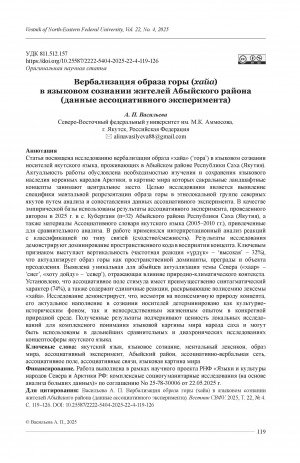
This article investigates the verbalization of the image of “Khaya” (‘mountain’) in the linguistic consciousness of Yakut language speakers residing in the Abyysky District of the Republic of Sakha (Yakutia). The relevance of the study is determined by the need to document and preserve the linguistic heritage of Arctic indigenous peoples, whose worldviews assign a central role to sacred landscape concepts. The aim of the research is to identify the specifics of the mental representation of the mountain image within an ethnolocal group of northern Yakuts through the analysis and comparison of data from an associative experiment. The empirical basis comprises the results of an associative experiment conducted by the author in 2025 in the village of Kuberganya of the Abyysky District (n=32), alongside materials from the Associative Dictionary of the Yakut Language (2005-2010) for comparative analysis. The study employed interpretive analysis of responses, classified according to the type of associative links (similarity/contiguity). The findings reveal the dominance of a spatial code in the perception of the concept. The key feature is verticality (the frequent response “ürdük” - ‘high’ - 32%), which actualizes the image of the mountain as a spatial dominant, an obstacle, and an object to be overcome. A unique thematic emphasis on the North (“khaar” - ‘snow’, “khotu doidu” - ‘North’) was identified among the Abyy respondents, reflecting the influence of the natural and climatic context. It was established that the associative field of the stimulus is predominantly syntagmatic in nature (74%) and also contains singular responses that reveal the polysemy of the lexeme ‘khaya’. The study demonstrates that, despite the polysemous nature of the concept, its actual content in the speakers' consciousness is determined by both the cultural-historical background and direct life experience within a specific natural environment. The obtained results underscore the value of local studies for a comprehensive understanding of the Yakut people's linguistic worldview and can be utilized in further comparative and diachronic research on the Yakut language's conceptual sphere.
Васильева, А. П.
Вербализация образа горы (хайа) в языковом сознании жителей Абыйского района (данные ассоциативного эксперимента) / А. П. Васильева ; Северо-Восточный федеральный университет им. М. К. Аммосова // Вестник Северо-Восточного федерального университета им. М. К. Аммосова. - 2025. - Т. 22, N 4 (102). - С. 119-126. - DOI: 10.25587/2222-5404-2025-22-4-119-126
DOI: 10.25587/2222-5404-2025-22-4-119-126


Количество страниц: 11 с.
- Языкознание. Филология. Художественная литература > Языкознание и языки. Лингвистика > Якутский (саха),
- Общественные науки. Образование > Фольклор,
- НАУКА ЯКУТИИ > ОБЩЕСТВЕННЫЕ НАУКИ > Фольклор,
- НАУКА ЯКУТИИ > ЯЗЫКОЗНАНИЕ. ФИЛОЛОГИЯ. ЛИТЕРАТУРОВЕДЕНИЕ. ХУДОЖЕСТВЕННАЯ ЛИТЕРАТУРА > Языкознание и языки. Лингвистика.
- 1. Абдуллина Гульфира Рифовна, Алимбаева Гульшаян Габсалямовна. Особенности табуированной и эвфемистической охотничьей лексики в башкирском, тувинском и якутском эпическом фольклоре = Features of taboo and euphemistic hunting vocabulary in Bashkir, Tuvan and Yakut epic folklore
- 2. Покатилова Надежда Володаровна. От полевой фольклористики к теоретической. Об эволюции исследовательского подхода Н. В. Емельянова к эпосу олонхо = Folkloristics from field to theory. Development of N. V. Emelyanov’s research approach to olonkho
- 3. Кожевников Николай Николаевич, Данилова Вера Софроновна. Сравнительная матрица для анализа мифов и эпосов = Comparative matrix for the analysis of myths and epics
- 4. Магидович Марина Леонидовна, Иванов Максим Васильевич. Скрытые патриархальные коннотации в образе женщины богатырки в якутском олонхо = Hidden patriarchal connotations in the image of a warrior woman in the Yakut olonkho
- 5. Ларионова Анна Семеновна. Ритмический каданс в джиэрэтии ырыа якутского олонхо вилюйской традиции: уровень композиционной структуры = Rhythmic cadence in jieretii yrya the Yakut olonkho of the Vilui tradition: composition structure level
- 6. Торотоев Гаврил Григорьевич. Перевод на язык саха ономастических единиц казахского героического эпоса "Кобыланды Батыр" = Translation of onomastic units of the Kazakh heroic epic “Kobylandy Batyr” into the Sakha language
- 7. Готовцева Лина Митрофановна. Фразеологизмы в тексте олонхо К. Г. Оросина "Нюргун Боотур Стремительный": идеографическая классификация = Phraseological units in the text of K. G. Orosin’s olonkho “Nurgun Bootur the Swift”: an ideographic classification
- 8. Руфова Елена Степановна. Языковая репрезентация гендерных стереотипов в японских и русских народных песнях = Linguistic representation of gender stereotypes in Japanese and Russian folk songs
- 9. Андросова Фекла Семеновна. Некоторые особенности индигирского говора северо-восточной группы говоров якутского языка (на материале олонхо Д. М. Слепцова "Кётёр Мюлгюн") = Some features of the Indigir dialect in the northeastern group of Yakut dialects: the case of the D.M. Sleptsov`s olonkho “The Flying Mulgun”
- 10. Божедонова Алла Евгеньевна, Замалетдинов Радиф Рифкатович, Юсупова Альфия Шавкетовна. Семантика и функции наименований мастей лошади в тюркских эпосах: опыт сравнительного анализа = Semantics and functions of horse coat colors in Turkic epics: an experience of comparative analysis
- 11. Вестник Северо-Восточного федерального университета им. М. К. Аммосова, 2025, N 4 (40), 2025, №4 (40)
The article analyses the specific forms of figurative verbs in order to identify and describe these forms in the texts of the olonkho and to determine the peculiarities of their use by olonkhohut-narrators. The relevance of the research lies in the insufficient study of the use of figurative vocabulary in epic texts. The novelty of the study lies in the fact that for the first time the functionality of specific forms of figurative verbs is considered as an object of research. The material for the study was the texts of the central epic tradition of Yakutia. In this work we used the method of solid sampling to collect figurative verbs from epic texts; component analysis based on dictionary definitions to reveal the semantics of words; the method of contextual analysis to reveal different meanings and shades of meanings of the studied verbs in context depending on their functions. We analyzed 212 figurative verbs, some of which are repeated in the olonkho texts. Among the specific forms of figurative verbs, the using of the base form, the form of instantaneousness and uniqueness, the form of mobility, the form of separate multiplicity, and the form of uniform multiplicity were found. As it turned out, in these species forms figurative verbs are involved, in general, in the description of the appearance of the main characters and minor characters and their movements, in the description of housing, everyday objects, natural phenomena and animals. The peculiarity of the use of species forms, according to the results of our analysis, is that depending on the situation, the specifics of the characters, the narrated action and the development of the plot of the olonkho, the narrator can combine species forms. For example, the form of mobility is used in active actions; the form of instantaneousness and one-timeness – in fragments where the characters act immediately; the form of separate multiplicity – in describing the movements of the characters, oriented on gait; and the form of uniform multiplicity – in defining the movements of the characters according to their complexion. Therefore, in our opinion, the olonkhohut’s special ability to combine the species forms of figurative verbs in the telling of the olonkho represents their artistic mastery.
Герасимова, Л. Н. Видовые формы образных глаголов в текстах олонхо / Л. Н. Герасимова ; Северо-Восточный федеральный университет им. М. К. Аммосова // Вестник Северо-Восточного федерального университета им. М. К. Аммосова. Серия "Эпосоведение". - 2025. - N 4 (40). - С. 220-230. - DOI: 10.25587/2782-4861-2025-4-220-230
DOI: 10.25587/2782-4861-2025-4-220-230

Количество страниц: 19 с.
- Общественные науки. Образование > Фольклор,
- Языкознание. Филология. Художественная литература > Языкознание и языки. Лингвистика > Тюркские языки,
- НАУКА ЯКУТИИ > ОБЩЕСТВЕННЫЕ НАУКИ > Фольклор,
- НАУКА ЯКУТИИ > ЯЗЫКОЗНАНИЕ. ФИЛОЛОГИЯ. ЛИТЕРАТУРОВЕДЕНИЕ. ХУДОЖЕСТВЕННАЯ ЛИТЕРАТУРА > Языкознание и языки. Лингвистика.
- 1. Абдуллина Гульфира Рифовна, Алимбаева Гульшаян Габсалямовна. Особенности табуированной и эвфемистической охотничьей лексики в башкирском, тувинском и якутском эпическом фольклоре = Features of taboo and euphemistic hunting vocabulary in Bashkir, Tuvan and Yakut epic folklore
- 2. Покатилова Надежда Володаровна. От полевой фольклористики к теоретической. Об эволюции исследовательского подхода Н. В. Емельянова к эпосу олонхо = Folkloristics from field to theory. Development of N. V. Emelyanov’s research approach to olonkho
- 3. Кожевников Николай Николаевич, Данилова Вера Софроновна. Сравнительная матрица для анализа мифов и эпосов = Comparative matrix for the analysis of myths and epics
- 4. Магидович Марина Леонидовна, Иванов Максим Васильевич. Скрытые патриархальные коннотации в образе женщины богатырки в якутском олонхо = Hidden patriarchal connotations in the image of a warrior woman in the Yakut olonkho
- 5. Ларионова Анна Семеновна. Ритмический каданс в джиэрэтии ырыа якутского олонхо вилюйской традиции: уровень композиционной структуры = Rhythmic cadence in jieretii yrya the Yakut olonkho of the Vilui tradition: composition structure level
- 6. Торотоев Гаврил Григорьевич. Перевод на язык саха ономастических единиц казахского героического эпоса "Кобыланды Батыр" = Translation of onomastic units of the Kazakh heroic epic “Kobylandy Batyr” into the Sakha language
- 7. Готовцева Лина Митрофановна. Фразеологизмы в тексте олонхо К. Г. Оросина "Нюргун Боотур Стремительный": идеографическая классификация = Phraseological units in the text of K. G. Orosin’s olonkho “Nurgun Bootur the Swift”: an ideographic classification
- 8. Руфова Елена Степановна. Языковая репрезентация гендерных стереотипов в японских и русских народных песнях = Linguistic representation of gender stereotypes in Japanese and Russian folk songs
- 9. Андросова Фекла Семеновна. Некоторые особенности индигирского говора северо-восточной группы говоров якутского языка (на материале олонхо Д. М. Слепцова "Кётёр Мюлгюн") = Some features of the Indigir dialect in the northeastern group of Yakut dialects: the case of the D.M. Sleptsov`s olonkho “The Flying Mulgun”
- 10. Герасимова Лилия Николаевна. Видовые формы образных глаголов в текстах олонхо = Specific forms of figurative verbs in olonkho texts
- 11. Вестник Северо-Восточного федерального университета им. М. К. Аммосова, 2025, N 4 (40), 2025, №4 (40)
The article presents a comparative analysis of the semantics and functions of horse coat colors in Turkic epic traditions, based on the Yakut olonkho “Dyray, Son of a Horse” and the Tatar epic “Idegey”. The research employed a comprehensive methodology combining structural-semiotic, mythopoetic, and comparative-typological approaches. The author systematized coat color terminology according to A. S. Krasnikov’s classification, revealing significant quantitative and qualitative differences between traditions: the elaborate system of Yakut olonkho (14 basic colors, 2 sub-colors, 9 markings) and the reduced system of the Tatar epic (8 basic colors with no sub-colors and minimal markings). A functional analysis demonstrated that the Yakut tradition features a multifunctional model dominated by the comparative function (color as the basis for extended epic similes), while the Tatar tradition exhibits a bifunctional model emphasizing identificational and social status functions. A semantic analysis revealed different codes: in olonkho, the cosmological code dominates, with colors clearly linked to the tripartite structure of the universe (Upper – Middle – Lower worlds); in “Idegey”, the social code prevails, marking estate hierarchy and supplemented by Islamic ethical connotations. A comparative-typological study identified the common Turkic core of color symbolism (white/black opposition, positive marking of white, ambivalence of black, distinctiveness of piebald colors) and traces its transformation in local traditions. The Yakut tradition preserves the archaic mythological type with cosmological semantics and detailed color characteristics; the Tatar tradition demonstrates a transformed historical-heroic type with social marking and categorical color perception. The research contributes to understanding the mechanisms of epic tradition functioning, reveals the dialectics of universal and local elements in Turkic epic, and outlines prospects for further comparative study of color symbolism in folklore texts.
Божедонова, А. Е. Семантика и функции наименований мастей лошади в тюркских эпосах: опыт сравнительного анализа / А. Е. Божедонова, Р. Р. Замалетдинов, А. Ш. Юсупова ; Северо-Восточный федеральный университет им. М. К. Аммосова, Казанский федеральный университет // Вестник Северо-Восточного федерального университета им. М. К. Аммосова. Серия "Эпосоведение". - 2025. - N 4 (40). - С. 201-219. - DOI: 10.25587/2782-4861-2025-4-201-219
DOI: 10.25587/2782-4861-2025-4-201-219