Количество страниц: 15 с.
- Общий отдел > Газеты. Пресса. Журналистика,
- Языкознание. Филология. Художественная литература > Языкознание и языки. Лингвистика > Якутский (саха),
- НАУКА ЯКУТИИ > ЯЗЫКОЗНАНИЕ. ФИЛОЛОГИЯ. ЛИТЕРАТУРОВЕДЕНИЕ. ХУДОЖЕСТВЕННАЯ ЛИТЕРАТУРА > Языкознание и языки. Лингвистика,
- НАУКА ЯКУТИИ > ОБЩИЙ ОТДЕЛ > Газеты. Пресса. Журналистика.
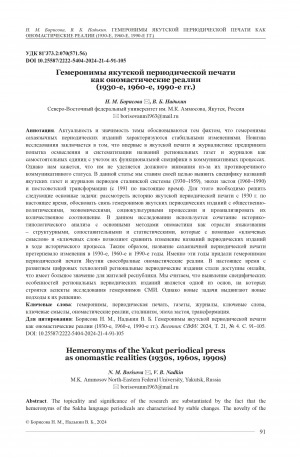
The topicality and significance of the research are substantiated by the fact that the hemeronyms of the Sakha language periodicals are characterised by stable changes. The novelty of the research consists of the first attempt in the Yakut press and journalism to comprehend and systematise the titles of regional newspapers and periodicals as independent units, considering the functional specificity of the titles in the communicative processes. Nevertheless, we suggest that titles have been overlooked due to their contradictory communicative status. In this article our purpose is to identify the specificity of the titles of Yakut newspapers and periodicals of the Stalinist System (1930-1959), the era of Stagnation (1960-1990) and the post-Soviet transformation (from 1991 to the present day). For this purpose, it is necessary to explain the following main tasks: to review the history of the Yakut periodical press from 1930 to the present period, to explain the relevance of the hemeronyms of Yakut periodicals to the socio-political, economic, sociocultural processes and to analyse the quantitative ratio of the hemeronyms. This research is based on the combination of historical-typological analysis with the main methods of onomastics as a branch of linguistics - structural, comparative and statistical. The use of key meanings and key words allows for a comparison of the evolution of periodical titles throughout history. Therefore, the title of the Sakha language periodical press evolved in the 1930s, 1960s, and 1990s. Basically, these years provided the hemeronyms of the periodical press in Yakutia specific onomastic realities. In these days, the regional periodicals have become available online due to the development of digital technologies, making it of great advantage for the inhabitants of the republic. In our opinion, the identification of specific features of regional periodicals is one of the bases on which the aspects of the research of media hemeronyms are based. Meanwhile, new challenges are bringing new approaches to the solution.
Борисова, Н. М.
Гемеронимы якутской периодической печати как ономастические реалии (1930-е, 1960-е, 1990-е гг.) / Н. М. Борисова, В. Б. Надькин ; Северо-Восточный федеральный университет им. М. К. Аммосова // Вестник Северо-Восточного федерального университета им. М. К. Аммосова. - 2024. - Т. 21, N 4 (98). - С. 91-105. - DOI: 10.25587/2222-5404-2024-21-4-91-105
DOI: 10.25587/2222-5404-2024-21-4-91-105
Количество страниц: 12 с.
- Языкознание. Филология. Художественная литература > Языкознание и языки. Лингвистика > Якутский (саха),
- Языкознание. Филология. Художественная литература > Языкознание и языки. Лингвистика > Русский язык,
- НАУКА ЯКУТИИ > ЯЗЫКОЗНАНИЕ. ФИЛОЛОГИЯ. ЛИТЕРАТУРОВЕДЕНИЕ. ХУДОЖЕСТВЕННАЯ ЛИТЕРАТУРА > Языкознание и языки. Лингвистика.
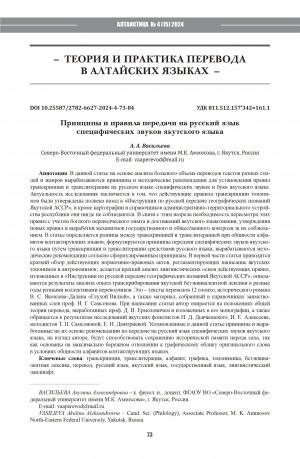
Based on the analysis of a large volume of translations of texts of different styles and genres, this article formulates the principles and guidelines for establishing rules for transcription and transliteration in Russian of specific sounds and letters of the Yakut language. The relevance of the study lies in the fact that the current rules for the transcription of geographic names were approved half a century ago in the “Instructions for the Russian translation of geographical names of the Yakut ASSR”. With the exception of cartography and reference books of the administrative and territorial structure of the republic, they are not observed anywhere. In this regard, there is a need to revise these rules, taking into account the vast translation experience and achievements of Yakut linguistics, to approve new rules, and to develop mechanisms for state and public control over their observance. The article defines the difference between transcription and transliteration in the case of common alphabets of the contacting languages; formulates the principles of transmitting specific sounds of the Yakut language via transcription and transliteration by means of the Russian language; and develops guidelines in accordance with the formulated principles. In the first part, the article provides a brief overview of the current legal acts governing the spelling of Yakut geographical and personal names. It also briefly analyses the linguistic foundations of the current rules set out in the Instructions. In addition, the article describes the results of the analysis on transcribing Yakut non-equivalent vocabulary in different years by different teams of translators. These are the translations of 12 olonkho, the historical novel “Remote Vilyui” by Vasily Dalan, as well as the material collected in the reference books of borrowed words by Professor Nikolay Samsonov. While writing this article, the author relied on the provisions of the general theory of translation developed by professor Dmitry Ermolovich and set out in his monograph, and also refers to the results of research by Yakut phoneticians Dyachkovsky and Alekseev, methodologists Samsonova and Dmitrieva. The principles established in this article and the recommendations developed on their basis for the translation of specific sounds of the Yakut language into Russian, in the author’s opinion, will contribute to the preservation of the historical memory of the Sakha people because they translate with the most care the graphic appearance of the original word in the context of the common alphabets of the contacting languages.
Васильева, А. А.
Принципы и правила передачи на русский язык специфических звуков якутского языка / А. А. Васильева ; Северо-Восточный федеральный университет имени М. К. Аммосова // Вестник Северо-Восточного федерального университета им. М. К. Аммосова. Серия "Алтаистика". - 2024. - N 4 (15). - С. 73-84. - DOI: 10.25587/2782-6627-2024-4-73-84
DOI: 10.25587/2782-6627-2024-4-73-84

Количество страниц: 14 с.
The article analyzes the functionality of 8 translated terms in the Yakut language submitted for approval to the terminological commission of the Sakha language under the Government of the Sakha Republic (Yakutia) in the period from 2023 to 2024. The relevance of the research is determined by the increasing need to develop terms in the Yakut language in connection with the expansion of the sphere of functioning of the Yakut language, as one of the official languages of the republic, in all spheres of public life. The purpose of the article is to unify the Russian-Yakut translation of industry terms by analyzing the functionality of translated terms in the Yakut language. In the development of the analysis methodology, they were based on the analysis schemes of translated terms proposed by L. A. Afanasyev-Teris and G. G. Torotoev, and also relied on the generally accepted requirements for terms in Russian terminology. As a result of the study, a scheme for analyzing the functionality of a translated term was approved: 1) definition of the scope of the term; 2) study of the history of the origin of the term; 3) morphological analysis of the new term by composition; 4) study of the lexical and semantic meaning of the root of the new term using existing sources; 5) experimental analysis of the new term as part of phrases. Of the proposed terminological neologisms, the functional terms are dahabyl ‘administrative’, sangany killarii ‘innovation’, uramny ‘art’, tuheen ‘tax’, barillaan kuolastaahyn ’primaries’, terminological neologisms nyurgun meaning ‘hero’, kyhalgha meaning ‘problem’ and doydumsakh meaning ‘patriot’ need to find other translation options into the Yakut language. The Yakut version doyduha kihi of the term “patriot” can, under certain conditions, enter the lexical and semantic system of the Yakut language.
Манчурина, Л. Е.
Анализ функциональности переводных терминов на якутском языке / Л. Е. Манчурина, А. Д. Максимова ; Северо-Восточный федеральный университет им. М. К. Аммосова // Вестник Северо-Восточного федерального университета им. М. К. Аммосова. Серия "Алтаистика". - 2024. - N 4 (15). - С. 23-36. - DOI: 10.25587/2782-6627-2024-4-23-36
DOI: 10.25587/2782-6627-2024-4-23-36
Количество страниц: 10 с.
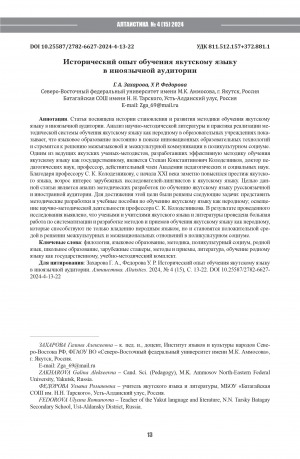
The article is devoted to the analysis of the historical experience of teaching the Yakut language to Russian-speaking and foreign audiences in Yakutia. An analysis of academic and methodological literature and the practice of implementing a methodological system on this problem in educational institutions of the republic shows that language education is constantly in search of innovative educational technologies and strives to solve interlingual and intercultural communication in a multicultural society. One of the leading Yakut scholars and methodologists who have developed an effective methodology for teaching the Yakut language as the state language was Professor Stepan Kolodeznikov, Doctor of Pedagogical Sciences, full member of the Academy of Pedagogical and Social Sciences. Thanks to Professor Kolodeznikov, since the beginning of the 21st century, the prestige of the Yakut language has noticeably increased and the interest of foreign linguistic researchers in the Yakut language has increased sharply. The purpose of this study is to analyze the academic and methodological thought on teaching the Yakut language as a non-native language in schools of the republic. To achieve this goal, we put forward the following tasks: an analysis of academic and methodological literature on the theory and didactics of interlingual and intercultural communication; coverage of the research activities of Professor Kolodeznikov, the founder of a unique academic school for teaching the Yakut language to Russian-speaking students, foreign students and foreign interns; generalization of the results of the work. A lot of work has been done to develop and systematize methods for teaching the Yakut language as a non-native language for Russian-speaking and foreign citizens. Thanks to our scholars and teachers, innovative educational technologies in language education have been developed, which contribute not only to mastering a non-native language, but also become a positive environment in solving interethnic relations in a multicultural society.
Захарова, Г. А.
Исторический опыт обучения якутскому языку в иноязычной аудитории / Г. А. Захарова, У. Р. Федорова ; Северо-Восточный федеральный университет им. М. К. Аммосова, Батагайская СОШ имени Н. Н. Тарского // Вестник Северо-Восточного федерального университета им. М. К. Аммосова. Серия "Алтаистика". - 2024. - N 4 (15). - С. 13-22. - DOI: 10.25587/2782-6627-2024-4-13-22
DOI: 10.25587/2782-6627-2024-4-13-22
Количество страниц: 8 с.
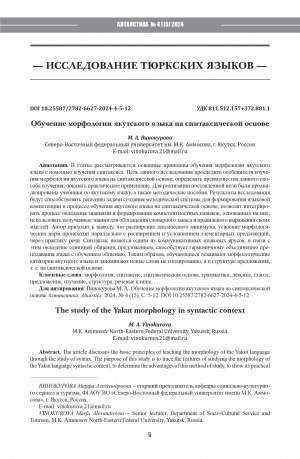
The article discusses the basic principles of teaching the morphology of the Yakut language through the study of syntax. The purpose of this study is to trace the features of studying the morphology of the Yakut language syntactic context, to determine the advantages of this method of study, to show its practical application. To achieve this goal, textbooks on the Yakut language, as well as methodological manuals, were analyzed. The results of the study will contribute to solving the problem of creating a methodological system for the formation of linguistic competence in the process of teaching the Yakut language syntactic context; they will integrate the process of acquiring knowledge and forming competence skills based on them, expressed in the use of acquired knowledge to enrich vocabulary and the correct expression of one’s thoughts. The author comes to the conclusion that the expansion of the lexical minimum, the assimilation of morphological norms occurs in parallel with the expansion and complication of elementary sentences, through practice in speech. Syntax is one of the communicative language tiers; in this regard, mastering the unit of communication, the sentence, contributes to the harmonious combination of language teaching with communication training. Thus, students master the morphological categories of the Yakut language and memorize new words not in isolation, but in the sentence structure, i.e. in syntactic context.
Винокурова, М. А.
Обучение морфологии якутского языка на синтаксической основе / М. А. Винокурова ; Северо-Восточный федеральный университет им. М. К. Аммосова // Вестник Северо-Восточного федерального университета им. М. К. Аммосова. Серия "Алтаистика". - 2024. - N 4 (15). - С. 5-12. - 10.25587/2782-6627-2024-4-5-12
DOI: 10.25587/2782-6627-2024-4-5-12

Количество страниц: 6 с.
- Языкознание. Филология. Художественная литература > Языкознание и языки. Лингвистика > Якутский (саха),
- НАУКА ЯКУТИИ > ЯЗЫКОЗНАНИЕ. ФИЛОЛОГИЯ. ЛИТЕРАТУРОВЕДЕНИЕ. ХУДОЖЕСТВЕННАЯ ЛИТЕРАТУРА > Языкознание и языки. Лингвистика,
- КНИГАКАН > Все народы > Эвенки (тунгусо-маньчжурская группа языков) > Языкознание.
- 1. Народы и культуры Северной Азии в контексте научного наследия Г. М. Василевич: сборник научных статей, 2020
- 2. Покатилова Надежда Володаровна. Об одной линии преемственности в становлении поэтики: А. Е. Кулаковский и Г. В. Баишев - Алтай Сарын = On continuity in the formation of poetics: A. E. Kulakovsky and G. V. Baishev - Altan Saryn
- 3. Варламов Александр Николаевич. Образ лося в мировоззрении и фольклоре тунгусо-маньчжурских народов: к вопросу о ранней истории тунгусов = The image of a moose in the worldview and folklore of tungusmanchu peoples: on the question of earlier history of tungus
- 4. Варламова Юлия Александровна, Варламов Александр Николаевич. Сибирь" в эвенкийском фольклоре: к вопросу об этимологии топонима = "Siberia" in the evenki folklore: to the question of etymology of toponym
- 5. Варламова Юлия Александровна, Дьяконова Мария Петровна. Об эвенкийском космониме "Чапактэ - территория беличьих гнезд" в обозначении созвездия "Плеяды" = About the evenki cosmonym "Chapakte - territory of squirrel nests" in the designation of the constellation "Pleiades"
- 6. Орлов Владимир Афанасьевич. Установка для измерения зенитно-азимутальных координат осей широких атмосферных ливней космических лучей: диссертация на соискание ученой степени кандидата технических наук, 1973
- 7. Яковлева Маргарита Прокопьевна. Классификация мифологических персонажей в эвенкийских героических сказаниях Н. Г. Трофимова = Classification of mythological characters in the evenk heroic tales by N.G. Trofimov
- 8. Петрова Валентина Алексеевна. Аудитория и ее влияние на творческое мастерство исполнителя эвенского эпоса = The audience and its influence on the creative skill of the performer of the even epic
- 9. Кузьмина Айталина Ахметовна. Из истории исследований мифологических основ якутского героического эпоса олонхо = From the history of research on the mythological foundations of the yakut heroic epos olonkho
- 10. Данилова Анна Николаевна. И. И. Иванов как собиратель фольклора Сунтарского улуса = I. I. Ivanov as a collector of folklore of the Suntar ulus
- 11. Ларионова Анна Семеновна. Вилюйская экспедиция М. Н. Жиркова 1943 г.: особенности работы с исполнителями = M. N. Zhirkov’s Vilyuysk expedition of 1943: features of work with performers
- 12. Чарина Ольга Иосифовна. Записи фольклора 1946 г. в Русском Устье: заимствованные сказки = Folklore records of 1946 in Russkoe Ustye: the borrowers fairy tales
- 13. Мыреева Анастасия Никитична. Судьба северного народа в историко-биографических романах А. В. Кривошапкина = The fate of the northern people in the historical and biographical novels OF A.V. Krivoshapkin
- 14. Ушницкая Наталья Юрьевна. Глаголы перемещения в эвенкийской языковой картине мира = Overcoming space in the evenk language picture of the world
- 15. Кириллина Мария Афанасьевна. Драма поэта как жанровое образование (на материале стихотворных драм И.М. Гоголева) = Poet’s drama as a genre formation (on the example of poetry dramas by I. M. Gogolev)
- 16. Охлопкова Жанна Валерьевна. Сюжетообразующий "Миф о северных кочевниках" в северном тексте литературы Якутии = The plot-forming "Myth of the northern nomads" in the northern text of the literature of Yakutia
- 17. Ефремова Екатерина Михайловна. Монтажные лирические формы в поэзии И. М. Гоголева: поэтика и архитектоника = Installation lyrical forms in the poetry of I. M. Gogolev: poetics and architectonics
- 18. Абрамова Мария Алексеевна, Гончарова Галина Савитовна, Костюк Всеволод Григорьевич. Влияние выбора родного языка на аккультурационные стратегии индивида (на примере РС(Я)) = The influence of native language on acculturation strategies of the individual (for example, RS(YA))
- 19. Васильева Ольга Валерьевна. Коренные народы Севера: проблемы развития в рамках периферийного капитализма = Indigenous peoples of the north: problems of development in the conditions of peripheral capitalism
- 20. Санникова Яна Михайловна. Традиционное хозяйство коренных народов Арктики накануне и в период постсоветских трансформаций в Якутии = Traditional economy of indigenous peoples of the Arctic on the eve and during the post-soviet transformations in Yakutia
- 21. Гончаров Николай Сергеевич. Факторы нестабильности пищевой безопасности в Аллаиховском улусе Республики Саха (Якутия) = Arctic "Laboratory" of food resources in Allaikhovskii district of the Republic of Sakha (Yakutia)
- 22. Маклашова Елена Гавриловна. Полиэтничность и поликультурность якутской Арктики: к некоторым особенностям функционирования = Polyethnicity and multiculturalism of the yakut Arctic: to some features of functioning
- 23. Астахова Ирина Сергеевна. "Настоящие" юкагиры: взгляд сквозь призму социологического исследования = "Real" yukagirs: a look through the prism of sociological research
- 24. Томаска Алена Георгиевна. Особенности миграционных процессов Арктической зоны Якутии = Features of migration processes in the arctic regions of Yakutia
- 25. Васильева Римма Иннокентьевна. Этнические группы якутов в условиях инокультурного окружения (по материалам полевых исследований) = Ethnic groups of yakuts in a foreign cultural environment (based on materials field research)
- 26. Унру Софья Александровна. Персонажи современного необрядового фольклора эвенков = Characters of modern non-ritual folklore of the evenks
- 27. Кузьмина Раиса Петровна. Концептуализация жалости в эвенской языковой картине мира = Conceptualization of pity in even’s language picture of the world
- 28. Романова Екатерина Назаровна, Октябрьская Ирина Вячеславовна. Тренды российской этнографии XX в.: Г. М. Василевич и ее вклад в методологию этнографического сибиреведения = Trends in russian ethnography of the XXth century: G. M. Vasilevich and her contribution to the methodology of ethnographic studies of Siberia
- 29. Петров Пантелеймон Пантелеймонович. Один пример арендных отношений между тунгусским родом и золотопромышленниками (вторая половина XIX в.) = One example of the rental relationship between the tunguska clan and gold miners (the second half of the XIX century)
- 30. Попова Наталья Иннокентьевна. Национальный институт в регионе: традиции, современные исследования и перспективы развития = The national institute in the region: traditions, modern research and development prospects
- 31. Андреева Тамара Егоровна. Тунгусоведение в институте гуманитарных исследований и проблем малочисленных народов Севера: этапы истории и перспективы развития = Tungusology in the institute for humanities research and indigenous studies of the North: stages of history and development prospects
- 32. Акимова Валентина Семеновна. Вклад Г. М. Василевич в типологизацию эвенкийского (тунгусского) кафтана = G. M. Vasilevich’s contribution то the typologization of the evenki (tungussky) caftan
- 33. Варавина Галина Николаевна. Календарная культура северных общностей: традиции, обрядность, символика (на примере эвенов и эвенков) = Calendar culture of northern communities: traditions, rituals, symbols (using the example of evens and evenks)
- 34. Курилова Самона Николаевна. Наименования оленя в языке тундровых юкагиров = Names of the reindeer in tundra yukaghir
- 35. Жукова Людмила Николаевна. Средства передвижения у юкагиров: лодки (традиции и современность) = Yukagir boats: traditions and modernity
- 36. Баишева Саргылана Макаровна. Этнические особенности пространственного развития коренных малочисленных народов Севера прибрежной части якутской Арктики = Ethnic features of the spatial development of the indigenous peoples of the coastal part of the yakut Arctic
- 37. Бравина Розалия Иннокентьевна. Самодийский след в якутской культуре = Samodian trace in yakut culture
- 38. Ушницкий Василий Васильевич. Этапы заселения предками эвенков территории Якутии = The stages of settlement by the ancestors of the evenks of Yakutia
- 39. Алексеева Сардаана Анатольевна, Долгунова Карина Юрьевна. Югюлятцы Вилюйского улуса Якутии: проблемы этногенеза и этнической истории = Yugulyats of Vilyui district of Yakutia: problems of ethnogenesis and ethnic history
- 40. Сулейманов Александр Альбертович. Научное изучение юкагиров Якутии в 1980 е годы = The scientific study of the yukaghirs of Yakutia in 1980-ies xx century
- 41. Васильев Валерий Егорович. К терминам "Шаман" и "Кам" у тунгусов и тюрков: опыт лингвистических и этнографических параллелей между эвенками и саха = То the terms “Shaman" and "Kam" among tungus and turks: experience of linguistic and ethnographic parallels between evenks and sakha
- 42. Николаев Егор Револьевич. О тунгусо-маньчжурских заимствованиях в лексико-тематической группе "Пища" в якутском языке (по лексикографическим материалам) = On the tungus-manchu borrowings of the lexical-thematic group "Food" in the yakut language (based on lexicographic materials)
- 43. Саввинов Павел Олегович. Сохранение культурно-национальной идентичности якутских эмигрантов = Preservation of the cultural and national identity of yakut emigrants
- 44. Прокопьева Александра Николаевна. Костяные гребни кулун-атахской культуры Якутии = Bone combs of the kulun atakh culture of Yakutia
- 45. Слепцова Айталина Алексеевна. Изделия из кости в якутских погребениях = Bone products in yakut burials
- 46. Федорова Айталина Родионовна. О некоторых представлениях народов циркумполярного мира о мамонте = About some ideas of the peoples of the circumpolar world about the mammoth
- 47. Яковлева Капитолина Максимовна, Михайлова Саргылана Михайловна. Растительный орнамент в якутских украшениях: красота со смыслом = Floral ornament in yakut jewelry: beauty with meaning
- 48. Филиппова Виктория Викторовна. Эвенкийское население Хатанго-Анабарского региона: динамика численности и расселения в XX-XXI вв. = Evenki of the Khatango-Anabar region: dynamics of population and settlement in the XX-XXI centuries
- 49. Санникова Яна Михайловна. Традиционные хозяйственные занятия коренного населения Анабарского региона Якутии на рубеже XX - XXI вв. в контексте исследования культурного ландшафта = Traditional economic activity of the indigenous population of the Anabar region of Yakutia at the turn of the XX-XXI centuries in the context of cultural and landscape research
- 50. Бойтунова Светлана Иннокентьевна. Истоки книжности народов Севера (1812 - XX в.): историческая реконструкция = The origins of the bookishness of the North peoples (1812-1917): historical reconstruction
- 51. Максимова Саргылана Васильевна, Бойтунова Светлана Иннокентьевна. Культурный код этнолога Уллы Йохансен в дарственной коллекции Национальной библиотеке Республики Саха (Якутия) = Ethnologist Ulla Johansen's cultural code in the donation collection of the National library of the Republic of Sakha (Yakutia)
- 52. Петров Пантелеймон Пантелеймонович. Загадочная "Земля якутского дворянина": история одной карты Северо-Востока Азии и Аляски (XVIII в.) = Mysterious “Land of the yakut nobleman": the history of a map of Northeast Asia and Alaska (XVIII centure)
- 53. Курилов Гаврил Николаевич. Отражение в языке юкагиров одной из древних культурных традиций = Language in the disclosure of one of the cultural traditions of the ancient yukagirs
- 54. Яковлев Айтал Игоревич, Новгородов Айсен Станиславович. Культурная память в повседневной жизни современных якутов (к постановке проблемы) = Cultural memory in the everyday life of modern yakuts (to the statement of the problem)
The paper deals with semantic adaptation of Yakut words in Evenki patois recorded in "Evenki-Russian Dictionary" comprised by A. N. Myreeva. Semantic shifts of Yakut loanwords in Evenki are compared with modern Yakut literary vocabulary. It is well known that loanwords from other languages serve as a reliable source for studying the modern state of a language, being an important tool for tracking vocabulary origins, genetic relations, and historical contacts. To understand the influence of other peoples on the indigenous languages of the Russian Far East and North it is necessary to record and document new words and their meanings.
Дьячковский, Ф. Н.
Семантическое освоение якутских слов в говорах эвенков Якутии (на материале "Эвенкийско-русского словаря" А. Н. Мыреевой) / Дьячковский Ф. Н. ; Институт гуманитарных исследований и проблем малочисленных народов Севера СО РАН // Народы и культуры Северной Азии в контексте научного наследия Г. М. Василевич : сборник научных статей / ответственный редактор Л. И. Миссонова ; редакционная коллегия: А. Н. Варламов, Н. И. Данилова, Е. Г. Маклашова [и др.] ; рецензенты: Т. В. Аргунова, Т. Г. Басангова, В. Н. Давыдов ; ответственный за выпуск М. П. Дьяконова. - Якутск : ИГИиПМНС СО РАН, 2020. - С. 234-239. - DOI: 10.25693/Vasilevich.2020.044
DOI: 10.25693/Vasilevich.2020.044

Издательство: Издательство Академии наук СССР
Год выпуска: 1976
Серия, номер выпуска: II, кн. 1
Количество страниц: 222 с.

Количество страниц: 11 с.
Васильева, Р. И.
Функционирование языка саха в полиэтнической языковой среде (на материале полевого исследования в Красноярском крае) / Васильева Р. И. ; Институт гуманитарных исследований и проблем малочисленных народов Севера // Диалекты в языке и культуре : сборник научных статей по материалам Всероссийской научно-практической конференции, посвященной 100-летию со дня рождения доктора филологических наук М. С. Воронкина, 95-летию со дня рождения доктора филологических наук С. А. Иванова, 95-летию со дня рождения кандидата филологических наук П. С. Афанасьева / [редакционная коллегия: Ю. М. Борисова, Н. А. Сивцева, А. А. Скрябина, Е. Р. Николаев ; рецензенты: И. Е. Алексеев, Л. М. Готовцева]. - Якутск : ИГИиПМНС, 2024. - С. 161-171.

Количество страниц: 7 с.
- Языкознание. Филология. Художественная литература > Языкознание и языки. Лингвистика > Якутский (саха),
- НАУКА ЯКУТИИ > ЯЗЫКОЗНАНИЕ. ФИЛОЛОГИЯ. ЛИТЕРАТУРОВЕДЕНИЕ. ХУДОЖЕСТВЕННАЯ ЛИТЕРАТУРА > Языкознание и языки. Лингвистика,
- КНИГАКАН > Все народы > Эвенки (тунгусо-маньчжурская группа языков) > Языкознание.
Алексеева, С. А. О некоторых заимствованных терминах из языка саха в материальной культуре тунгусов по экспедиционным материалам Виктора Николаевича Васильева / Алексеева С. А. ; Институт гуманитарных исследований и проблем малочисленных народов Севера // Диалекты в языке и культуре : сборник научных статей по материалам Всероссийской научно-практической конференции, посвященной 100-летию со дня рождения доктора филологических наук М. С. Воронкина, 95-летию со дня рождения доктора филологических наук С. А. Иванова, 95-летию со дня рождения кандидата филологических наук П. С. Афанасьева / [редакционная коллегия: Ю. М. Борисова, Н. А. Сивцева, А. А. Скрябина, Е. Р. Николаев ; рецензенты: И. Е. Алексеев, Л. М. Готовцева]. - Якутск : ИГИиПМНС, 2024. - С. 145-151.

Количество страниц: 6 с.
- Языкознание. Филология. Художественная литература > Языкознание и языки. Лингвистика > Якутский (саха),
- НАУКА ЯКУТИИ > ЯЗЫКОЗНАНИЕ. ФИЛОЛОГИЯ. ЛИТЕРАТУРОВЕДЕНИЕ. ХУДОЖЕСТВЕННАЯ ЛИТЕРАТУРА > Языкознание и языки. Лингвистика,
- КНИГАКАН > Все народы > Эвенки (тунгусо-маньчжурская группа языков) > Языкознание.
Стручков, К. Н.
Иноязычные заимствования в эвенкийском языке (на примере лексики) / Стручков К. М. ; Институт гуманитарных исследований и проблем малочисленных народов Севера // Диалекты в языке и культуре : сборник научных статей по материалам Всероссийской научно-практической конференции, посвященной 100-летию со дня рождения доктора филологических наук М. С.Воронкина, 95-летию со дня рождения доктора филологических наук С. А. Иванова, 95-летию со дня рождения кандидата филологических наук П. С. Афанасьева / [редакционная коллегия: Ю. М. Борисова, Н. А. Сивцева, А. А. Скрябина, Е. Р. Николаев ; рецензенты: И. Е. Алексеев, Л. М. Готовцева]. - Якутск : ИГИиПМНС, 2024. - С. 105-110.