
Открытый доступ означает, что читать книгу можно из любого места, где есть интернет. Нужно только авторизоваться или зарегистрироваться на сайте.
Закрытый доступ к изданию возможен только в стенах Национальной библиотеки РС (Я).
Картинка тематической коллекции сгенерировано с помощью чат-бота "Kandinsky"
Количество страниц: 5 с.
Modern technological development has an impact on all spheres of public life, as well as on the legal regulation of public relations. Of particular importance in the modern regulatory system are the technical standards that underlie the functioning of digital technologies. They influence the mechanism of legal regulation and the choice of instruments of government influence and legal regulation of social relations related to the use of digital technologies. Transformations in law are also associated with the emergence of technologies capable of imitating human intellectual activity, and therefore, there are discussions in the scientific community about the potential legal personality of artificial intelligence. The most obvious changes in modern legal reality are related to the use of digital technologies for the purposes of implementing law.
Болотаева, О. С. Правовое регулирование цифровых технологий и цифровая трансформация права / Болотаева О. С. ; Северо-Восточный федеральный университет им. М. К. Аммосова, Юридический факультет // Вестник Северо-Восточного федерального университета им. М. К. Аммосова. Серия "История. Политология. Право". - 2024, N 2 (34). - С. 5-9. - DOI: 10.25587/2587-5612-2024-2-5-9
DOI: 10.25587/2587-5612-2024-2-5-9
Ответственность: Китов Юрий Валентинович (Научный руководитель)
Количество страниц: 5 с.
The article examines the use of artificial intelligence in the preservation and dissemination of Yakutia’s cultural heritage. It is noted that despite the great potential of AI in this field, its application in the strategy of preservation and popularization of Yakutia’s cultural heritage remains insufficient. The problems of cultural heritage preservation in Yakutia are considered and the possibilities of using AI are discussed.
Четвертакова, Д. Е. Использование искусственного интеллекта в стратегии сохранения и популяризации культурного наследия Якутии: возможности, препятствия и перспективы / Д. Е. Четвертакова ; научный руководитель Ю. В. Китов ; Арктический государственный институт культуры и искусств // Аргуновские чтения - 2024. - Якутск : ИЦ НБ РС (Я). - (Культура Арктики ; вып. 15). - С. 717-721.
Количество страниц: 4 с.
The paper considers the possibility of using Russian artificial intelligence systems in journalistic practice. The opening of access to AI systems, as well as their interfaces (API), provides new opportunities for the preparation and processing of materials for publication.
Сивцев, Д. М. Технологии "искусственного интеллекта" в практической работе журналиста / Д. М. Сивцев, А. М. Андреев ; Северо-Восточный федеральный университет им. М. К. Аммосова, Филологический факультет //Аргуновские чтения - 2024. - Якутск : ИЦ НБ РС (Я). - (Культура Арктики ; вып. 15). - С. 594-597.

Ответственность: Охлопкова Анна Семеновна (Научный руководитель)
Количество страниц: 3 с.
The article is devoted to the study of the status of artificial intelligence in civil cases and the right to authorship. The possibility and advantage of recognizing artificial intelligence technologies as subjects of copyright is analyzed. The practice of solving this issue in foreign countries is given.
Уарова, Н. А. Искусственный интеллект как новый субъект авторского права: возможность и целесообразность / Н. А.Уарова ; научный руководитель А. С. Охлопкова ; Северо-Восточный федеральный университет им. М. К. Аммосова, Юридический факультет // Аргуновские чтения - 2024. - Якутск : ИЦ НБ РС (Я). - (Культура Арктики ; вып. 15). - С. 556-558.

Ответственность: Михайлова Анна Викторовна (Научный руководитель)
Количество страниц: 5 с.
- Искусственный интеллект,
- Общий отдел > Информационные технологии. Вычислительная техника,
- Общественные науки. Образование > Демография. Статистика. Социология,
- НАУКА ЯКУТИИ > ОБЩЕСТВЕННЫЕ НАУКИ > Демография. Статистика. Социология,
- НАУКА ЯКУТИИ > ОБЩИЙ ОТДЕЛ > Информационные технологии. Вычислительная техника.
Applications of artificial intelligence in human resource management include recruiting, employee training, employee relationship management, etc. Artificial intelligence can improve the efficiency of recruiting through automated resume screening, interview assistance, and employee referrals; it can provide personalized training, on line training and skill assessment; it helps in communicating, caring and motivating employees, which increases the overall competitiveness of the company.
Янь Ци. Искусственный интеллект в управлении человеческими ресурсами: практика китайских компаний / ЯньЦи ; научный руководитель А. В. Михайлова ; Северо-Восточный федеральный университет им. М. К. Аммосова, Финансово-экономический институт // Аргуновские чтения - 2024. - Якутск : ИЦ НБ РС (Я), 2024. - (Культура Арктики ; вып. 15). - С. 262-266.

Ответственность: Михайлова Анна Викторовна (Научный руководитель)
Количество страниц: 7 с.
The article discusses the use of artificial intelligence in personnel management in China. The author analyzes the current state of development of artificial intelligence in China and its impact on personnel management. The author concludes that artificial intelligence provides many opportunities to improve human resource management in China and can significantly optimize processes, improve customer service and improve staff efficiency.
Го Линь. Искусственный интеллект в управлении персоналом Китая / Го Линь ; научный руководитель А. В. Михайлова ; Северо-Восточный федеральный университет им. М. К. Аммосова, Финансово-экономический институт // Аргуновские чтения - 2024. - Якутск : ИЦ НБ РС (Я). -(Культура Арктики ; вып. 15). - С. 273-279

2024, N 1 (28)
Издательство: ИЦ НБ РС (Я)
Год выпуска: 2024
Номер (№): 1 (28)
Количество страниц: 116 с.
Количество страниц: 5 с.
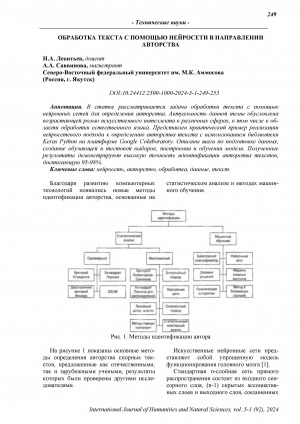
The article deals with the task of text processing using neural networks to determine authorship. The relevance of this topic is due to the increasing role of artificial intelligence in various fields, including natural language processing. A practical example of implementation of neural network approach to text authorship determination using Keras Python library on Google Colaboratory platform is presented. The steps of data preparation, creation of training and test samples, model building and training are described. The obtained results demonstrate high accuracy of text authorship identification, reaching 95-98%.
Леонтьев, Нь. А. Обработка текста с помощью нейросети в направлении авторства / Н. А. Леонтьев, А. А. Саввинова ; Северо-Восточный федеральный университет им. М. К. Аммосова // Международный журнал гуманитарных и естественных наук. - 2024. - N 5-1 (92). - C. 249-253. - DOI: 10.24412/2500-1000-2024-5-1-249-253
DOI: 10.24412/2500-1000-2024-5-1-249-253

Количество страниц: 7 с.
The article analyzes the speeches of the speakers at the plenary session of the Kant Congress, held in Kaliningrad in April 2024 in connection with the 300th anniversary of the thinker. The plenary session was chaired by Deputy Prime Minister of Russia Dmitry Chernyshenko, who not only gave the floor to speak, but also revealed the content of the new stage of human development with his questions and comments to them widely. As well as the goal, objectives and, in general, the problems of resolution, which represent a necessary and sufficient condition for the normal functioning and development of human civilization. The speeches of the speakers - Mogilevsky D.N., Alikhanov A.A., Fedorov A.A., Anisimov N.Y., Pishchulin A.Yu., Avetisyan A.I., as well as international expert Sandajoy Joshi from India showed that the modern tasks facing humanity are extremely complex and require the combined efforts of all progressive humanity. In the context, the hypothesis formulated by Professor Fedorov, the Head of the Baltic Federal University, is of great interest, focusing not only on the co-development of man and artificial intelligence, but also on the emergence of a third world person completely autonomous from the world - the world of artificial intelligence. No less relevant are the questions posed by the director of the Federal Centre for Humanitarian Practices of the Russian State University for the Humanities A.Yu. Pishchulin, because a distinctive feature of modern digital technology is that it creates a crisis of confidence in what has served people faithfully for thousands of years.
Саввинов, А. С. Размышления после Кантовского конгресса, посвященного 300-летию мыслителя / А. С. Саввинов ; Северо-Восточный федеральный университет им. М. К. Аммосова // Вестник Северо-Восточного федерального университета им. М. К. Аммосова. Серия "Педагогика. Психология. Философия. - 2024. - 2 (34). - C. 71-77. - DOI: 10.25587/2587-5604-2024-2-71-77
DOI: 10.25587/2587-5604-2024-2-71-77

Количество страниц: 14 с.
- Искусственный интеллект,
- Общественные науки. Образование > Народное образование. Воспитание. Обучение. Организация досуга > Профессиональное и среднее специальное образование,
- НАУКА ЯКУТИИ > ОБЩЕСТВЕННЫЕ НАУКИ > Народное образование. Воспитание. Обучение. Организация досуга > Профессиональное и среднее специальное образование.
The article is devoted to the topical problems of the use of generative neural networks of artificial intelligence, online tools and services in the educational process and in the professional activity of a teacher. It considers the experience of creating and applying interactive exercises and tasks in the educational process of teaching Russian language to foreigners and humanities students of Russian literature. Some prospects for the use of generative neural networks of artificial intelligence in the professional activity of a teacher are touched upon. The inevitable process of digitalization of education is changing the ways in which participants in the learning process learn and interact. The use of information and digital technologies in education leads to improved accessibility of educational resources, individualization of learning, and improvement of knowledge assessment methods. However, it is important to remember that digitalization carries a number of threats, such as the possibility of additional distance learning, cybersecurity issues, as well as challenges in the field of data privacy. It should also be noted that the philosophical principles of digitalization of education should take into account humanistic values and focus not only on technological aspects, but also on the development of the personality of the learning digital generation, the formation of its critical thinking, the ability to self-development and self-improvement. For them, the digital environment, information and digital technologies are the main aspect of their life.
Бурцева, С. С.
Применение цифровых сервисов и генеративных нейросетей в обучении русскому языку как иностранному / С. С. Бурцева, Е. Е. Ядрихинская ; Северо-Восточный федеральный университет им. М. К. Аммосова // Вестник Северо-Восточного федерального университета им. М. К. Аммосова. Серия "Педагогика. Психология. Философия". - 2024. - 2 (34). - C. 5-18. - DOI: 10.25587/2587-5604-2024-2-5-18
DOI: 10.25587/2587-5604-2024-2-5-18