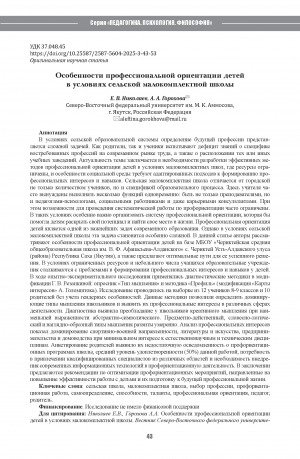
Особенности профессиональной ориентации детей в условиях сельской малокомплектной школы = Features of professional orientation of children in rural small schools
Статья в журнале
Русский
373.5.048:331.548(571.56-22)
10.25587/2587-5604-2025-3-43-53
сельская школа; малокомплектная школа; выбор профессии; профориентационная работа; самоопределение; способности; таланты; профессиональная ориентация; педагог; родитель; rural school; small-scale school; career choice; career guidance; self-determination; abilities; talents; professional orientation; teacher; parent
С. 43-53
Вестник Северо-Восточного федерального университета им. М. К. Аммосова = Vestnik of North-Eastern Federal Univercity: электронное научное периодическое издание
Якутск, Издательский дом СВФУ
Издается с 2016 г.
Выходит 4 раза в год
2587-5604 (online)
Вестник Северо-Восточного федерального университета им. М. К. Аммосова. Серия "Педагогика. Психология. Философия" : электронное научное периодическое издание / Федеральное государственное автономное образовательное учреждение высшего профессионального образования "Северо-Восточный федеральный университет имени М. К. Аммосова" ; главный редактор: А. Н. Николаев. - Якутск : Издательский дом СВФУ, 2015 - . - 2025, N 3 (38). - 113 с.
In the context of a rural educational system, determining a future profession is a difficult task. Both parents and students lack knowledge about the specifics of sought-after professions in the modern labor market, as well as the location of certain educational institutions. The relevance of the topic lies in the need to develop effective methods of vocational guidance for children in small schools, where resources are limited and the peculiarities of the social environment require adapted approaches to the formation of professional interests and skills. Rural small-scale schools differ from urban schools not only in the number of students, but also in the specifics of the educational process. Here, teachers are often forced to perform several functions at the same time: to be not only teachers, but also educational psychologists, social workers, and even career consultants. At the same time, opportunities for systematic career guidance are often limited. In such circumstances, it is especially important to organize a professional guidance system that would help children reach their potential and find their place in life. The professional orientation of children is one of the most important tasks of modern education. However, in conditions of rural small schools, this task becomes especially difficult. In this article, the authors examined the features of the professional orientation of children on the basis of the V. F. Afanasyev-Aldansky Cheriktey Secondary School in Cheriktey village of Ust-Aldansky District, Republic of Sakha (Yakutia), and will try to find optimal ways to successfully solve it. In the course of the experimental study, diagnostic techniques modified by G. V. Rezapkina were used: the “Type of Thinking” questionnaire and the “Profile” technique (a modification of the “Map of Interests” by A. Golomstock). The study was conducted on a sample of 12 students in grades 8-9 and 10 parents without taking into account gender characteristics. These methods made it possible to identify the dominant types of thinking of schoolchildren and identify their professional interests in various fields of activity. The diagnostics revealed the predominance of creative thinking among schoolchildren with the least expression of abstract-symbolic thinking. Objective-effective, verbal-logical, and visual-imaginative types of thinking are moderately developed. The analysis of professional interests showed the dominance of sports and military orientation, literature and art, entrepreneurship and home economics with minimal interest in natural sciences and technical disciplines. The survey of parents revealed their lack of awareness of the school’s career guidance programs, an average level of satisfaction (50%) with this job, the need to attract qualified specialists from various fields, and the need to introduce modern information technologies into career guidance activities. With limited resources and a small number of students, educational institutions face challenges in shaping children’s professional interests and skills. In conclusion, recommendations are made on optimizing career guidance measures aimed at improving the effectiveness of working with children and preparing them for future professional life.
Николаев, Е. В.
Особенности профессиональной ориентации детей в условиях сельской малокомплектной школы / Е. В. Николаев, А. А. Горохова ; Северо-Восточный федеральный университет им. М. К. Аммосова // Вестник Северо-Восточного федерального университета им. М. К. Аммосова. Серия "Педагогика. Психология. Философия". - 2025. - N 3 (39). - С. 43-53. - DOI: 10.25587/2587-5604-2025-3-43-53
DOI: 10.25587/2587-5604-2025-3-43-53
- Общественные науки. Образование > Экономика. Экономические науки. Политическая экономия > Труд. Наука о труде. Экономика труда. Организация труда,
- Общественные науки. Образование > Народное образование. Воспитание. Обучение. Организация досуга > Общеобразовательная школа. Дошкольные учреждения,
- НАУКА ЯКУТИИ > ОБЩЕСТВЕННЫЕ НАУКИ > Экономика. Экономические науки. Политическая экономия,
- НАУКА ЯКУТИИ > ОБЩЕСТВЕННЫЕ НАУКИ > Народное образование. Воспитание. Обучение. Организация досуга.
Войдите в систему, чтобы открыть документ

QR-код документа

Как сканировать QR-код?
Для пользователей Android:
- Скачайте приложение для сканирования QR-кодов (Google Play)
- Откройте скачанное приложение;
- Наведите камеру на QR-код.
Для пользователей iPhone:
- Откройте приложение "Камера";
- Наведите камеру на QR-код;
- Нажмите на всплывающее уведомление.