Место работы автора, адрес/электронная почта: Арктический государственный агротехнологический университет ; 677007, г. Якутск, ш. Сергеляхское 3 км., 3 ; https://agatu.ru/
Ученая степень, ученое звание: д-р с.-х. наук
Область научных интересов: Сельское хозяйство, лесное хозяйство
ID Автора: SPIN-код: 1474-5050, РИНЦ AuthorID: 1083858
Количество страниц: 7 с.
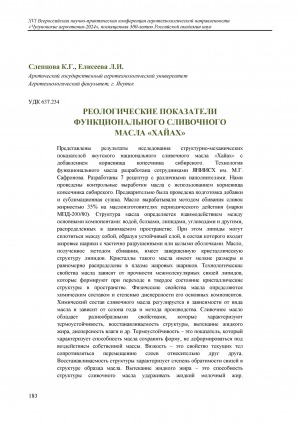
The results of a study of the structural and mechanical parameters of the Yakut national butter "Khayakh" with the addition of the rhizome of the Siberian kopeck are presented. The technology of functional oil was developed by the researchers of the Yakut Scientific Research Institute of Agriculture named after M.G. Safronov. 7 formulations with various fillers have been developed. We have carried out control oil production using the rhizome of the Hedysarum Siberian. Preliminary preparation of the additive and freeze drying was carried out. The oil was produced by churning cream with a fat content of 35% on batch oil manufacturers (brands MPD-200/80). The structure of the oil is determined by the interaction between the main components: water, proteins, lipids, carbohydrates and others distributed in the occupied space. In this case, lipids can unite with each other, forming a stable layer, which includes fat balls with partially destroyed or whole shells. The oil obtained by churning has a complete crystalline structure of lipids. The crystals of this oil are small in size and evenly distributed in the plasma of fat globules. The technological properties of the oil depend on the strength of the intermolecular bonds of lipids, which form crystalline structures in space during the transition to a solid state. The physical properties of the oil are determined by the chemical composition and the degree of dispersion of its main components. The chemical composition of butter is regulated depending on the type of butter and depends on the season of the year and the production method. Butter has a variety of properties that characterize thermal stability, recoverability of the structure, leakage of liquid fat, moisture dispersion, etc. Thermal stability is an indicator that characterizes the ability of an oil to retain its shape and not deform under the influence of its own mass. Viscosity is the property of flowing bodies to resist the movement of layers relative to each other. The recoverability of the structure characterizes the degree of reversibility of bonds in the structure of the oil sample. The outflow of liquid fat is the ability of the butter structure to retain liquid milk fat. The thermal stability was 0.91±0.004, the recoverability of the structure was 70.1±0.24%, the degree of free fat leakage was 4.93±0.15%.
Слепцова, К. Г.
Реологические показатели функционального сливочного масла "Хайах" / Слепцова К. Г., Елисеева Л. И. ; ФГБОУ ВО "Арктический государственный агротехнологический университет", Агротехнологический факультет // Чугуновские агрочтения : сборник научных статей по материалам XVI Всероссийской научно-практической конференции агротехнологической направленности "Чугуновские агрочтения", посвященной 300-летию Российской академии наук, 3-4 апреля 2024 г., г. Якутск. - Якутск : Издательский дом СВФУ, 2024. - С. 183-189.
Количество страниц: 5 с.
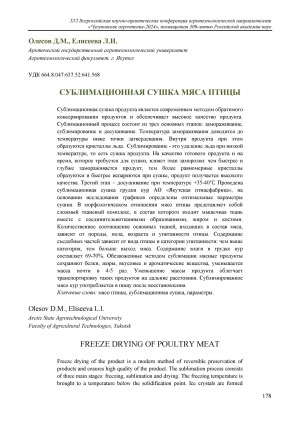
Freeze drying of the product is a modern method of reversible preservation of products and ensures high quality of the product. The sublimation process consists of three main stages: freezing, sublimation and drying. The freezing temperature is brought to a temperature below the solidification point. Ice crystals are formed inside the product. Sublimation is the removal of ice at a low temperature, that is, the drying of the product. The quality of the finished product and the time required for drying is affected by the freezing stage: the faster and deeper the product is frozen, the more uniform crystals form and evaporate faster during drying, the product turns out to be of high quality. The third stage is drying at a temperature of +35-40℃. Freeze-drying of chicken breasts of JSC Yakutsk Poultry Farm was carried out, based on the study of graphs, optimal drying parameters were determined. Morphologically, poultry meat is a tissue complex, which includes muscle tissue along with connective tissue formations, fat and bones. The quantitative ratio of the main tissues that make up the meat depends on the breed, sex, age and fatness of the bird. The content of edible parts depends on the type of bird and the fatness category: the higher the category, the greater the meat yield. The moisture content in chicken breast is 69-70%. Meat products dehydrated by sublimation retain proteins, fats, flavoring and aromatic substances, and the weight decreases by almost 4-5 times. Reducing the weight of the product makes it easier to transport such products over long distances. Freeze-dried chicken meat is eaten after recovery.
Олесов Д. М.
Сублимационная сушка мяса птицы / Олесов Д. М., Елисеева Л. И. ; ФГБОУ ВО "Арктический государственный агротехнологический университет", Агротехнологический факультет // Чугуновские агрочтения : сборник научных статей по материалам XVI Всероссийской научно-практической конференции агротехнологической направленности "Чугуновские агрочтения", посвященной 300-летию Российской академии наук, 3-4 апреля 2024 г., г. Якутск. - Якутск : Издательский дом СВФУ, 2024. - С. 178-182.
Количество страниц: 8 с.
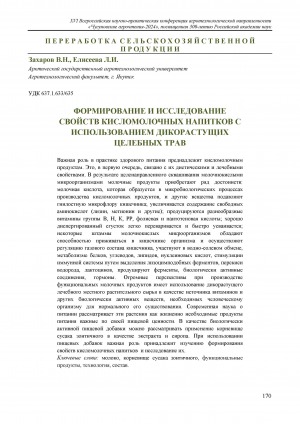
Fermented milk products play an important role in the practice of healthy eating. This is primarily due to their dietary and medicinal properties. As a result of targeted fermentation by lactic acid microorganisms, dairy products acquire a number of advantages: lactic acid, which is formed in the microbiological processes of production of fermented dairy products, and other substances suppress putrefactive intestinal microflora; the content of free amino acids (lysine, methionine and others) increases; a variety of vitamins of group B, H, K, PP, folic and pantothenic acids are produced; a well-dispersed clot is easily digested and quickly absorbed; some strains of lactic acid microorganisms have the ability to take root in the intestines of the body and regulate the gas composition of the intestine, participate in water-salt metabolism, metabolism of proteins, carbohydrates, lipids, nucleic acids, stimulation of the immune system by the release of lysozyme-like enzymes, hydrogen peroxide, lactocins, produce enzymes, biologically active compounds, hormones. The use of wild medicinal local plant raw materials as a source of vitamins and other biologically active substances necessary for the human body for its normal existence has great prospects in the production of functional dairy products. Modern nutrition science considers these plants as vital food products that are important in their nutritional value. As a biologically active food additive, it is possible to consider the use of the rhizome of the umbelliferous susak as an extract and syrup. When using food additives, an important role belongs to the study of the formation of the properties of fermented milk drinks and their research.
Захаров, В. Н.
Формирование и исследование свойств кисломолочных напитков с использованием дикорастущих целебных трав / Захаров В. Н., Елисеева Л. И. ; ФГБОУ ВО "Арктический государственный агротехнологический университет", Агротехнологический факультет //Чугуновские агрочтения : сборник научных статей по материалам XVI Всероссийской научно-практической конференции агротехнологической направленности "Чугуновские агрочтения", посвященной 300-летию Российской академии наук, 3-4 апреля 2024 г., г. Якутск. - Якутск : Издательский дом СВФУ, 2024. - С. 170-177.
Количество страниц: 10 с.
Елисеева, Л. И. Исследование сыропригодности молока коров для производства мюрюнского сыра / Л. И. Елисеева, П. А. Гоголева ; Арктический государственный агротехнологический университет // Вестник АГАТУ. - 2023. - N 4 (12). - C. 41-50.
Количество страниц: 9 с.
Елисеева, Л. И. Технологические аспекты использования вторичного молочного сырья в Якутии / Л. И. Елисеева, П. А. Гоголева, Е. В. Павлова ; Арктический государственный агротехнологический университет // Вестник АГАТУ. - 2022. - N 2 (6). - C. 32-40.
Количество страниц: 7 с.
Елисеева, Л. И. Биологическая ценность жиров мяса и субпродуктов якутского скота / Л. И. Елисеева ; Арктический государственный агротехнологический университет // Вестник АГАТУ. - 2021. - N 1 (1). - C. 26-32.
Издательство: Октаэдр
Год выпуска: 2019
Количество страниц: 104 с.
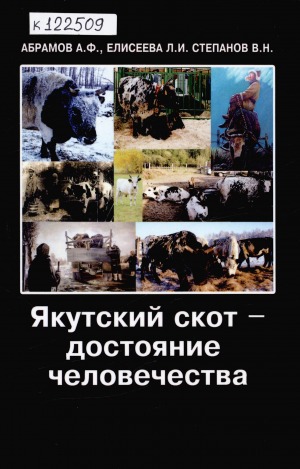
The monograph highlights the results of studies of the nutritional and biological value of meat and offal of Yakut cattle, the environmental and economic justification of the feasibility of its breeding and increase the number of livestock; irrefutable data are given that the Yakut cattle in milk and meat productivity is not inferior to cultural breeds and can take its rightful place in the production of high-quality meat and dairy products. The monograph is intended for a wide circle of scientists, agricultural specialists, workers of the processing enterprise, trade, university students and colleges